educational tips
Basketball Rules for Beginners: A Kid and Parent Guide
LitZone Team · Oct 18, 2026
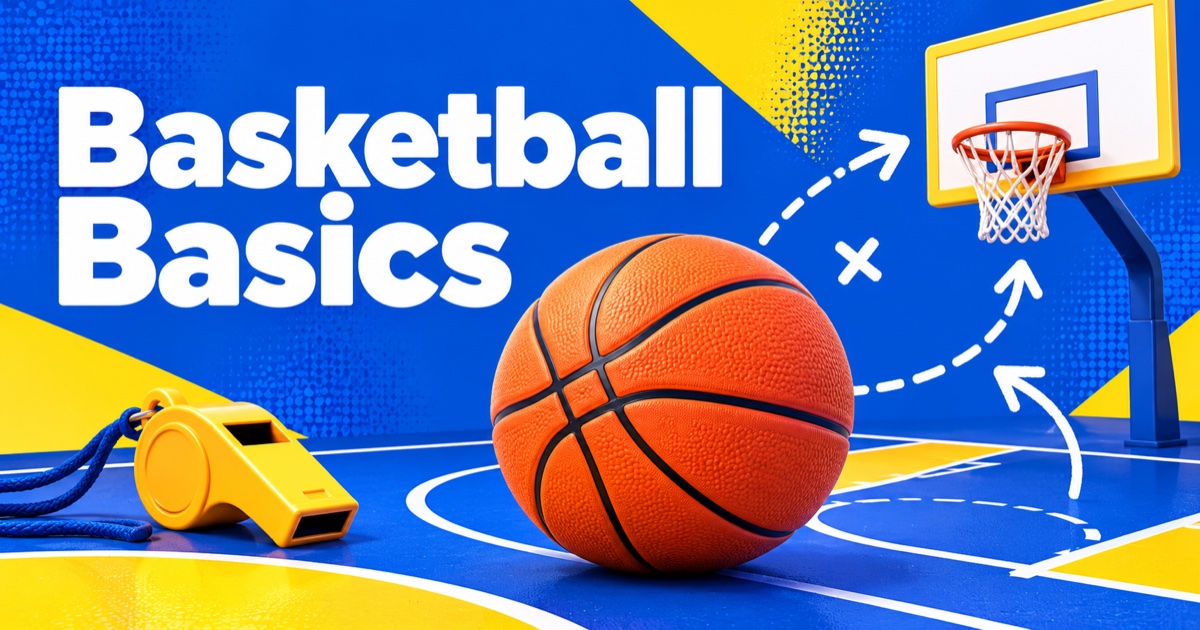
A first basketball game can feel like a stream of whistles, passes, numbers, and people changing direction. A child does not need to understand every rule before enjoying it. Start with the goal of the game, the meaning of the score, and the difference between having the ball and defending.
This is a beginner learning guide for children and parents. It explains common basketball ideas and uses fictional examples. Youth programs can adapt equipment, playing time, and rules, so a coach or the rules for your particular competition should answer questions about that game's exact format. A professional game on a screen is not a rulebook for every children's league.
Start with the two jobs
The team with the ball tries to create a scoring opportunity at its basket. The other team works to prevent that score and gain possession. When possession changes, the players' immediate jobs change too.
A simple watching question is, "Which team has the ball now?" Follow that with, "Which basket are they trying to score in?" These questions help a beginner notice the direction of play before concentrating on individual moves.
In an invented example, the Comets have the ball and pass toward their attacking basket. The Sparks are defending. A Comets player takes a shot and misses. If a Sparks player gains the rebound, the Sparks now have possession and can attack in the other direction. If a Comets player gains it, the Comets can continue their opportunity.
The example also shows why a missed shot does not always end a team's possession. Watch who gains control next. A parent can pause after one sequence and let the child retell it using the team names.
Read the points before the other numbers
In the scoring examples here, a made free throw counts as one point, a made two-point shot counts as two, and a made three-point shot counts as three. Three-point scoring depends on the relevant line and rules of the game being played; some beginner formats simplify scoring.
Suppose an imaginary team makes two two-point shots and one three-point shot. The total is 2 + 2 + 3 = 7 points. Three made shots do not mean three points. The value of each shot matters.
Now add two made free throws. Seven plus two gives nine. This is enough arithmetic for a first score-following activity. Your child can use fingers, counters, or a number line if that makes the calculation easier to explain.
Keep the game score separate from other statistics. A rebound and an assist describe useful actions, but they are not automatically extra points on the scoreboard. A fantasy game may use a different formula to award its own points. Our fantasy basketball scoring guide keeps those practice calculations separate from basketball scoring.
Notice passing, dribbling, and stopping
A pass sends the ball to a teammate. A dribble controls the ball through bouncing. Players use these actions to move the ball and create space. A child watching for the first time can count two passes in one possession without needing to name every kind of pass.
Basketball also has restrictions on moving while holding the ball and on stopping and restarting a dribble. The terms "traveling" and "double dribble" name common violations associated with those restrictions. Their detailed application belongs to the rules and officials for the game, so avoid teaching a single shortcut as if it explains every possible play.
For a family vocabulary activity, use this fictional sequence: catch the ball, dribble, stop, look, and pass. Ask which action sends the ball to a different person. Then ask which action involves bouncing. The answers are pass and dribble.
A pivot is a turn made while keeping the pivot foot in place. If a child is learning to play, a coach can show the appropriate footwork. When the goal is simply to follow a game, recognizing the word is a useful first step.
Understand why play pauses
A whistle can stop play for different reasons. The ball may have gone out of bounds, a violation may have occurred, or an official may have called a foul. Do not assume that every whistle means somebody has scored or that every stoppage has the same restart.
Out of bounds concerns the court boundary. An inbound pass brings the ball into play from outside that boundary. During a first game, the child can watch where the person making the inbound pass stands and which teammate receives the ball.
A foul is an infraction such as illegal contact. It differs from a violation such as a movement-rule infringement. The resulting restart or free throws depend on the situation and the competition's rules. A beginner can first learn to notice the official's signal and wait for the restart without having to predict every consequence.
A timeout is another kind of pause. It gives the teams a chance to stop and regroup under the game's rules. Our fictional story The Extra Pass begins around a timeout and follows a single decision after play resumes.
Keep time and periods in context
Games are divided into periods, but the number and length of those periods can differ. The word "quarter" describes one part of a four-part structure. Some games use halves or modified practice periods instead.
Before a youth game, check the posted format or ask the coach how time works. Do the teams play halves or quarters? Does the clock stop in the situations your child notices? How are substitutions handled? Those answers describe this game rather than every basketball competition.
For an at-home exercise, define your own fictional periods clearly. You might give the Comets four period scores of 8, 12, 10, and 9. Adding them gives 39 points. The activity uses four parts because that is the example you chose, not because every youth game must use that format.
Use the printable basketball score sheet to record period points and a final total. If you record running totals instead, label them that way so you do not accidentally add the same points more than once.
Try a five-question watching challenge
After one short sequence, ask: Who had possession first? Which direction were they attacking? Did the ball move through a pass or a dribble? Was the shot made or missed? Who controlled the ball afterward?
There is no need to answer a question when the camera did not show the event clearly. "I could not see" is a useful observation. It is more accurate than inventing a play to fill a gap.
Next, choose one word to explain. A child might say, "A rebound happened after the missed shot." Ask which event in the sequence supports that sentence. This connects rule vocabulary with reading, speaking, and observation.
Finish with a specific positive observation about teamwork. A player may have stayed ready for a pass, encouraged a teammate, or helped create space. For definitions you can return to as new words appear, use our basketball vocabulary guide. Learning a few connected ideas at a time gives the next game a familiar starting point.
Built for ages 8–13
Playing fantasy football with your kid?
Give them a team of their own, with kid-friendly football, reading, and math in one place.
Create their first fantasy team free

Ad-free. No chat. Built for kids.