educational tips
Printable Basketball Score Sheet for Kids: Track a Game Together
LitZone Team · Oct 18, 2026
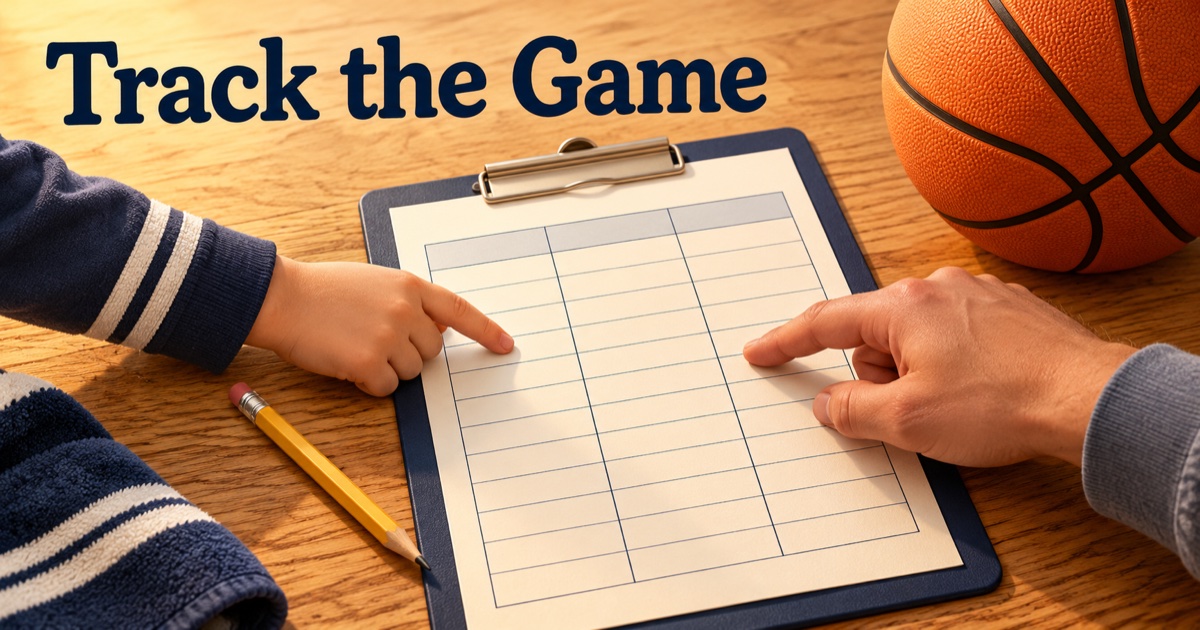
A basketball score sheet gives a child one small job during a game: notice what happens, record it, and check the total. It can turn a fast-moving game into a manageable numbers activity without requiring a parent to explain every detail at once.
Download the free basketball score sheet and stat tracker. The PDF includes a blank period-by-period record, a tracker for one player, and a fictional example with an answer key. It is a family learning resource, not an official league scorebook. Print the student pages first and keep the answer key separate if your child wants to solve the example independently.
Choose one recording job
Start with the team score if this is your child's first time keeping a record. Write the two team names before the game begins. At the end of each period, record the points each team earned during that period. The boxes are for period scores, so do not copy the running total into every box.
For example, if a scoreboard reads 8 after the first period and 20 after the second, the team earned 12 points in the second period. Writing 8 and 20 in the two period boxes would count the first period twice when you add the boxes later. A parent can help by asking, "How many new points were added?"
Some games use halves, quarters, shorter practice rounds, or an extra period. Label the boxes to match the game you are following. Leave unused boxes blank. The learning sheet does not set the rules for a school or youth league.
Choose a point when both people can pause and check the record. A break between periods is often easier than correcting every mark while the ball is moving. If you miss a play, leave a small question mark and check the displayed score when you can.
Separate baskets from points
For the scoring examples in this activity, a made two-point basket counts as 2 points, a made three-point basket counts as 3, and a made free throw counts as 1. A made basket and a point are different things to count.
The printable has separate rows for those three scoring events. Use tally marks to record how many of each event you notice. At the end, multiply the two-point tally by 2 and the three-point tally by 3. Then add the made free throws.
Here is an invented example. Rowan makes three two-point baskets, one three-point basket, and two free throws. Rowan has six successful scoring plays, but the point total is not six. The calculation is 3 x 2 + 1 x 3 + 2, which equals 11 points.
A useful explanation names the units: "Three baskets worth two points each make six points." That sentence tells another reader what the numbers mean. Writing only "3 x 2" leaves the reader to guess what is being counted.
Use the player tracker as a separate activity
The second part of the sheet follows one player. It has rows for scoring plays, rebounds, and assists. Those categories describe different contributions. The points calculation uses the scoring rows; it does not add rebounds and assists to the basketball scoreboard.
If your family also plays a fantasy game, keep that scoring formula on a separate page. A fantasy total can assign its own values to different statistics. Our fantasy basketball scoring practice guide walks through a clearly labeled learning formula. It should not be confused with the points scored in the game itself.
A younger child can follow only one category, such as made free throws. Another person can record the remaining categories. Watching one player throughout a game can be difficult, especially when the camera moves, so an incomplete learning record is acceptable. Label it as the plays you observed rather than presenting it as an official statistical record.
For a first attempt, use the fictional example instead of a live broadcast. The numbers stay still, and the child can explain each step without trying to watch the next play.
Check a four-period example
In the printable's fictional practice game, the Comets score 8, 12, 10, and 9 points in four periods. Add the period values: 8 + 12 = 20, then 20 + 10 = 30, then 30 + 9 = 39. The final total is 39 points.
Check the same total by grouping the numbers another way. Eight plus twelve makes twenty. Ten plus nine makes nineteen. Twenty plus nineteen still makes thirty-nine. Two methods that agree provide a useful arithmetic check.
Now imagine that the second-period box accidentally says 20 instead of 12. The sum becomes 47. Ask the child to compare the record with the original data and locate the mismatch. The point of the correction is to identify which number represents a period and which represents a running total.
For an extra challenge, invent a second team's period scores and compare the totals. Write the final difference as a number of points. Clearly label all invented data as practice so another reader will not mistake it for an actual game result.
Turn the record into a short explanation
After adding the scores, ask for one sentence about the table. "The Comets scored their most points in period two" is supported by the four values. "The Comets always play best in period two" is a much larger claim that one fictional game cannot establish.
A second sentence can describe a change. The Comets scored four more points in the second period than in the first because 12 - 8 = 4. They scored two fewer in the third than in the second because 12 - 10 = 2. Both statements use the same table without inventing a reason for the change.
If a child wants to explain why a team scored more, separate the observation from the possible explanation. A score table records results. It does not, by itself, show every pass, defensive choice, or substitution that produced them.
Pick the next step that fits
Keep the activity short enough that the child still enjoys the game. One practice example or one observed period can be a complete session. Date the sheet, label any missing observations, and let the child choose a category to follow next time.
For more practice with the numbers behind a game, use our basketball math activities. For help understanding the labels in a published statistical table, read how to read a basketball box score. The score sheet works best as a place to record and explain what a child can actually see.
Built for ages 8–13
Playing fantasy football with your kid?
Give them a team of their own, with kid-friendly football, reading, and math in one place.
Create their first fantasy team free

Ad-free. No chat. Built for kids.